
Do You Need a Visa to Move to Canada? 2026 Guide for Newcomers
Planning to move to Canada? Here are the visa types, fees, documents and step-by-step process newcomers need in 2026 — explained clearly, with no surprises.
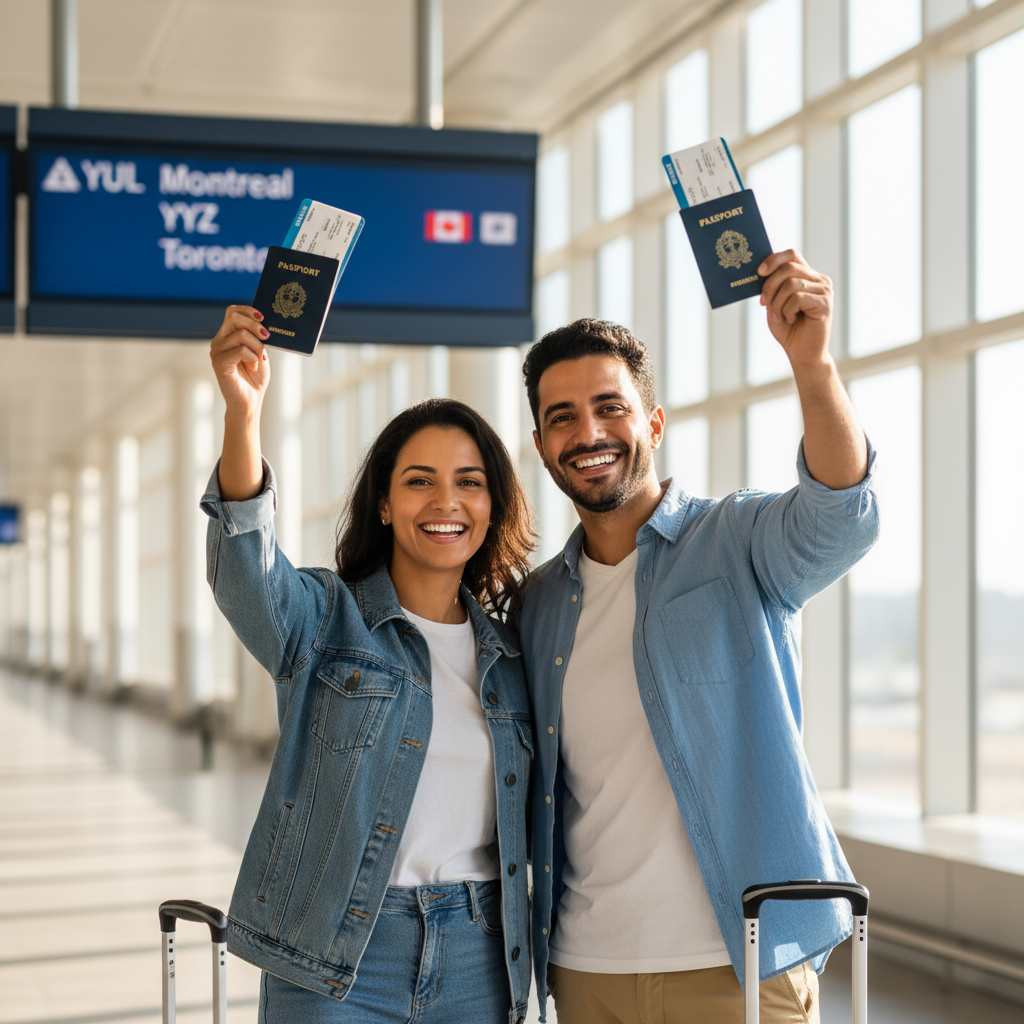
Most newcomers do need some form of authorization to enter Canada in 2026. Whether your trip is for tourism, study or work, you will need a visa or an electronic authorization from the Canadian government before you board. The exact requirement depends on your nationality — citizens of visa-exempt countries may travel with an eTA (Electronic Travel Authorization) instead of a full visa. Requirements vary by nationality, so check your eligibility on the official IRCC website.
The good news is that the process has become far more organized in recent years, and we will show you exactly what to do, how much it costs and how long it takes — all with figures updated for 2026.
Table of Contents
- Do you need a visa to enter Canada?
- What types of Canadian visa exist in 2026?
- How much does a Canadian visa cost in 2026?
- Which documents do you need?
- Step by step: how to apply for a Canadian visa
- How long does processing take?
- What can get your visa refused?
- Do you need a visa to reach Canada with a US layover?
- eTA Canada: when it applies and how it works
- Practical tips for couples planning to immigrate
- Frequently Asked Questions (FAQ)
- Sources
Do you need a visa to enter Canada?
For most newcomers, yes — you will need authorization to enter Canada for any purpose: tourism, study, work or transit. The key question is whether your nationality requires a full visa (TRV) or qualifies for the simpler eTA. Requirements vary by nationality, so check your eligibility on the official IRCC website before making any plans.
Here is a point that confuses many people: a visa and an eTA are different things. Travellers from visa-required countries need a visa, while the eTA is reserved for citizens of visa-exempt countries. Knowing which one applies to your passport is the first step before you buy a flight or make any plans.
If you are a couple planning the move, each of you will need your own authorization. Even if one of you comes as a student and the other on a spousal open work permit, both go through the application process individually.
We know this process creates anxiety — the fear of a refused visa comes up in nearly 15% of the conversations we have with people preparing to move. But with the right documentation, your chances are good.
What types of Canadian visa exist in 2026?
There are six main categories of authorization that newcomers use to enter Canada. The right one depends on the reason for your trip and how long you plan to stay.
- Visitor Visa (TRV) — for tourism or visiting family. Up to 6 months per entry. Does not allow work.
- Study Permit — for students in programs longer than 6 months. Valid for the length of the program plus 90 days. Allows work up to 24h/week during classes (2024+ rule).
- Work Permit (LMIA-based) — for those with a job offer backed by an LMIA. Duration follows the contract. Allows work for the specific employer.
- Open Work Permit (OWP) — for spouses of students/workers, PGWP holders, and similar. Duration varies by category. Allows work for any employer.
- Super Visa — for parents and grandparents of citizens/permanent residents. Up to 5 years per entry. Does not allow work.
- Transit Visa — for connecting through a Canadian airport. Up to 48 hours. Does not allow work.
Visitor Visa (tourism visa): The Temporary Resident Visa (TRV) is the most common for those who want to visit Canada. It allows stays of up to 6 months per entry and can be issued as single or multiple entry (the multiple-entry version is valid for up to 10 years or until the passport expires).
Study Permit: If your plan is to study in a program longer than 6 months, you need a Study Permit. This is the entry route that 39% of the people we support choose. You will need a Letter of Acceptance (LOA) from a DLI (Designated Learning Institution) before you apply. Since 2024, the Canadian government has capped the number of Study Permits issued, and provinces continue to operate with quotas in 2026 — so planning ahead is essential.
Work Permit: To work in Canada you need a valid job offer and, in most cases, an LMIA (Labour Market Impact Assessment) approved by the employer. Some LMIA-exempt categories also exist.
Open Work Permit (OWP) for a spouse: If one partner comes as a student in an eligible program or as a worker, the spouse can apply for an Open Work Permit. This is the situation for 70% of the couples we see arriving in Canada. The OWP allows you to work for any employer, which adds flexibility when landing that first job.
How much does a Canadian visa cost in 2026?
The total cost depends on the type of authorization, but here is a clear breakdown. These are the official IRCC fees as of March 2026, in Canadian dollars.
- Visitor Visa (TRV): $100 government fee + $85 biometrics = $185 CAD total
- Study Permit: $150 + $85 = $235 CAD total
- Work Permit: $155 + $85 = $240 CAD total
- Open Work Permit: $255 ($155 + $100 OWP holder fee) + $85 = $340 CAD total
- Super Visa: $100 + $85 = $185 CAD plus mandatory health insurance
- Family (couple, visitor): $100 x 2 + biometrics (up to $170 family cap) = around $370 CAD total
Note: these are government fees only. They do not include extra costs such as certified translations of documents, a medical exam (roughly $300-450 CAD), and photos in the Canadian standard.
For a couple where one comes as a student and the other on an OWP, the total in government fees alone is around $575 CAD — before biometrics, exams and translations.
The fear of running out of money in the first few months is the most common one we hear — 70% of the people we talk to mention it. If you are worried about the full budget for your move, plan it carefully and early.
Which documents do you need?
The paperwork changes by visa type, but there is a common base everyone must present. Here is the full list for the Visitor Visa (TRV), the most requested one:
- Valid passport — must be valid for at least 6 months beyond your planned departure date from Canada
- Form IMM 5257 completed digitally
- Two photos in the IRCC standard (35mm x 45mm, white background)
- Biometrics confirmation (appointment at a VAC — Visa Application Centre)
- Proof of funds — bank statements from the last 3-4 months showing sufficient money
- Employment letter or proof of ties to your home country (university enrolment, company, property)
- Travel history — previous passports with stamps help a lot
- Invitation letter (if applicable — when someone in Canada is inviting you)
- Travel insurance (not mandatory for the TRV, but strongly recommended)
For a Study Permit, add: a Letter of Acceptance (LOA) from a DLI; proof of tuition payment or the financial capacity to pay; a provincial attestation letter (PAL), mandatory since 2024; and proof of funds — a minimum of $20,635 CAD for 12 months of living costs (in addition to tuition), updated annually by IRCC.
For a Work Permit, add: a job offer with the LMIA number; an employment contract; and proof of your qualification for the position.
Practical tip: organize everything in a digital folder with clear names (e.g. “Bank_Statement_Jan2026.pdf”). The IRCC online system accepts uploads — and badly named or out-of-order documents slow the process down.
Step by step: how to apply for a Canadian visa
The Canadian visa application is 100% online since 2022. You do everything through the IRCC portal, with no need to visit a consulate. The only in-person step is biometrics collection at a VAC.
Step 1 — Create your IRCC account: Go to the official portal at ircc.canada.ca and create an IRCC Secure Account (formerly GCKey). Each person needs their own account — if you are a couple, that means two separate accounts.
Step 2 — Complete the online form: Answer the eligibility questionnaire. The system will tell you which form you need (IMM 5257 for visitor, IMM 1294 for study permit, and so on). Fill it in carefully — mistakes here delay everything.
Step 3 — Upload your documents: Upload all scanned documents as good-quality, legible PDFs, with a maximum size of 4MB per file.
Step 4 — Pay the fees: Payment is by international credit card (Visa, Mastercard, American Express). Fees are charged in Canadian dollars.
Step 5 — Book and complete biometrics: After payment, you receive a Biometrics Instruction Letter (BIL). You then book your fingerprint and photo collection at the nearest VAC. You have 30 days after receiving the BIL to complete biometrics. VACs are operated worldwide by partners such as VFS Global.
Step 6 — Wait for processing: Track the status through the IRCC portal. If the immigration officer needs more information, you receive a notification in your account.
Step 7 — Submit your passport (if approved): After approval, you receive a PPR (Passport Request). Send your passport to the VAC so the visa can be affixed to it. This takes 5 to 15 business days.
How long does processing take?
Processing time varies a lot by visa type and current demand. Here are the times IRCC estimated as of March 2026:
- Visitor Visa (TRV): 30-45 days
- Study Permit: 8-12 weeks
- Work Permit (with LMIA): 8-16 weeks
- Open Work Permit: 8-12 weeks
- Super Visa: 100-150 days
Figures verified on 31 March 2026. Check the official IRCC website for the most current information, as processing times vary by country of application.
If you are planning to arrive in Canada by a specific date (the start of a semester, for example), apply at least 4 months in advance. We have seen many couples leave it to the last minute and have to postpone everything.
What can get your visa refused?
A Canadian visa refusal is more common than it seems, and the most frequent reasons are predictable — which means they can be avoided. The main reasons for refusal are:
- Insufficient proof of funds — the officer needs to see that you have enough money to support yourself and to return home
- Weak ties to your home country — if you cannot show reasons to return (employment, property, dependent family), the refusal risk rises
- Limited travel history — applicants who have never travelled abroad present a higher risk profile to IRCC
- Incomplete or inconsistent documentation — data that does not match between the form and your documents
- Vague purpose of travel — “I want to see Canada” is weak; a detailed itinerary with hotel bookings and a return ticket is strong
- Inadmissibility — criminal records, health issues that pose a risk to the public system, or false statements in previous applications
What to do if your visa is refused? You can reapply as many times as you like — there is no limit. But reapplying with the same documents will produce the same result. Request the officer’s notes (GCMS notes) to understand exactly why you were refused, and fix the issue before trying again. Another option is to request a judicial review at the Federal Court, but this is expensive and rarely worth it for temporary visas.
Do you need a visa to reach Canada with a US layover?
If your flight connects through the United States, you may need two authorizations: the Canadian one and a US visa (such as a B1/B2). Even if you do not leave the airport in the US, many nationalities require a US visa to transit through American soil. Requirements vary by nationality — check your eligibility for both countries.
This is a trap that catches many people. Cheaper flights often connect through Miami, Houston or New York. If you do not hold a US visa, you may need to choose direct flights or routes that connect through countries which do not require a transit visa.
Alternative: direct flights to Toronto (YYZ) and Montreal (YUL) are available from several international hubs. They tend to be more expensive, but they remove the need for a US visa entirely.
eTA Canada: when it applies and how it works
The eTA (Electronic Travel Authorization) is an electronic authorization that costs just $7 CAD and is approved within minutes. However, it is only available to citizens of visa-exempt countries (such as many EU nations, Japan and Australia). Requirements vary by nationality, so check your eligibility on the official IRCC website.
If you hold dual citizenship of a visa-exempt country, you can travel using the eTA on that passport. There is also a specific situation: travellers who have held a Canadian visa in the last 10 years or who hold a valid US visa may be eligible for the eTA instead of a full visa for air travel. This rule was introduced in 2024 and remains valid in 2026.
Important: the eTA only applies to air travel. If you enter Canada by land, you need the conventional visa even when you are from a visa-exempt country.
Practical tips for couples planning to immigrate
If you are reading this as a couple thinking about moving to Canada, here are points we consider essential and that few people mention:
Apply together, but in separate accounts. Each of you needs your own IRCC account. But coordinate the applications so the documents are consistent — dates, addresses and financial proof should all match.
Think about the couple’s total cost. For a couple where one comes on a Study Permit and the other on an OWP, the total in fees and biometrics alone is around $575-660 CAD. Add certified translations, a medical exam (roughly $600-900 CAD for two), and flights. The initial investment easily runs into several thousand dollars before you set foot in Canada, so plan the full budget carefully.
If you have a pet, plan ahead. 58% of the people we support have pets. Bringing a pet to Canada requires a veterinary certificate, an up-to-date rabies vaccine and, depending on the species, additional documentation from the CFIA (Canadian Food Inspection Agency). Flights with a pet in the cabin or hold must be booked months in advance — spots are limited.
Choose your city based on data, not hype. Montreal, Toronto, Halifax, Hamilton and smaller cities such as Niagara/St. Catharines and Sherbrooke each have specific advantages — especially in housing cost and the job market. Research before you commit.
The partner on an OWP needs a job strategy. 30% of couples report that the OWP partner struggles to find work. Do not leave this until after you arrive. Start preparing a Canadian-format résumé, building an English/French LinkedIn profile and researching the local market before you move.
Frequently Asked Questions (FAQ)
Do you need a visa to enter Canada in 2026? For most travellers, yes — you need either a visa or an eTA to enter Canada for any purpose: tourism, study, work or transit. Which one applies depends on your nationality, so check your eligibility on the IRCC portal. The application is done online.
How much does a Canadian visa cost? The tourist visa (TRV) costs $185 CAD including biometrics. The Study Permit costs $235 CAD and the Work Permit $240 CAD. These are government fees — translation, medical exam and photos are extra.
How long does it take to get a Canadian visa? The tourist visa took 30 to 45 days as of March 2026. Study Permits and Work Permits take 8 to 16 weeks. It is wise to apply at least 4 months ahead of your planned travel date. Processing times vary by country of application.
Can I travel to Canada with only an eTA? Only if you are a citizen of a visa-exempt country. If you need a visa, you may still qualify for the eTA for air travel if you have held a Canadian visa in the last 10 years or hold a valid US visa. Requirements vary by nationality — verify on the official IRCC website.
Do I need a US visa if my flight to Canada connects through the US? Many nationalities need a US visa (such as a B1/B2) even to connect through US airports. If you do not hold one, choose direct flights to Canada or routes through countries that do not require a transit visa. Requirements vary by nationality.
What is the difference between a visa and a permit in Canada? The visa (TRV) is the sticker in your passport that allows entry into Canada. The permit (Study Permit or Work Permit) is the document that authorizes you to study or work inside the country. You need the visa to enter and the permit to carry out the activity — they are complementary documents.
How does the spousal work permit work in Canada? The spouse of a student in an eligible program can apply for an Open Work Permit (OWP), which allows work for any employer in Canada. The OWP costs $340 CAD including biometrics and is processed in 8-12 weeks. The student must be enrolled in a master’s, doctoral or eligible professional program.
Can I work in Canada on a tourist visa? No. The Visitor Visa (TRV) does not authorize paid work in Canada. Working without authorization breaches your entry conditions and can result in deportation and a future entry ban. To work, you need a valid Work Permit or Open Work Permit.
Sources
- IRCC — Find out if you need a visa for Canada: https://www.canada.ca/en/immigration-refugees-citizenship/services/visit-canada/eligibility.html
- IRCC — Processing times: https://www.canada.ca/en/immigration-refugees-citizenship/services/application/check-processing-times.html
- IRCC — How to apply for a Visitor Visa: https://www.canada.ca/en/immigration-refugees-citizenship/services/visit-canada/apply-visitor-visa.html
- IRCC — Study Permit: https://www.canada.ca/en/immigration-refugees-citizenship/services/study-canada.html
- IRCC — Work Permit: https://www.canada.ca/en/immigration-refugees-citizenship/services/work-canada.html
- IRCC — eTA (Electronic Travel Authorization): https://www.canada.ca/en/immigration-refugees-citizenship/services/visit-canada/eta.html
- IRCC — Biometrics: https://www.canada.ca/en/immigration-refugees-citizenship/campaigns/biometrics/facts.html
- VFS Global — Visa Application Centres: https://www.vfsglobal.ca/
This article was researched with the help of artificial intelligence and reviewed by Daitana Aguilar to ensure accuracy and relevance.
Thinking about your move to Canada? The Daitana concierge and the Comfort Living team can guide you through every step. Follow Daitana on Instagram @daitana.aguilar and subscribe on YouTube @daitanaaguilar for more on immigrating to Canada.